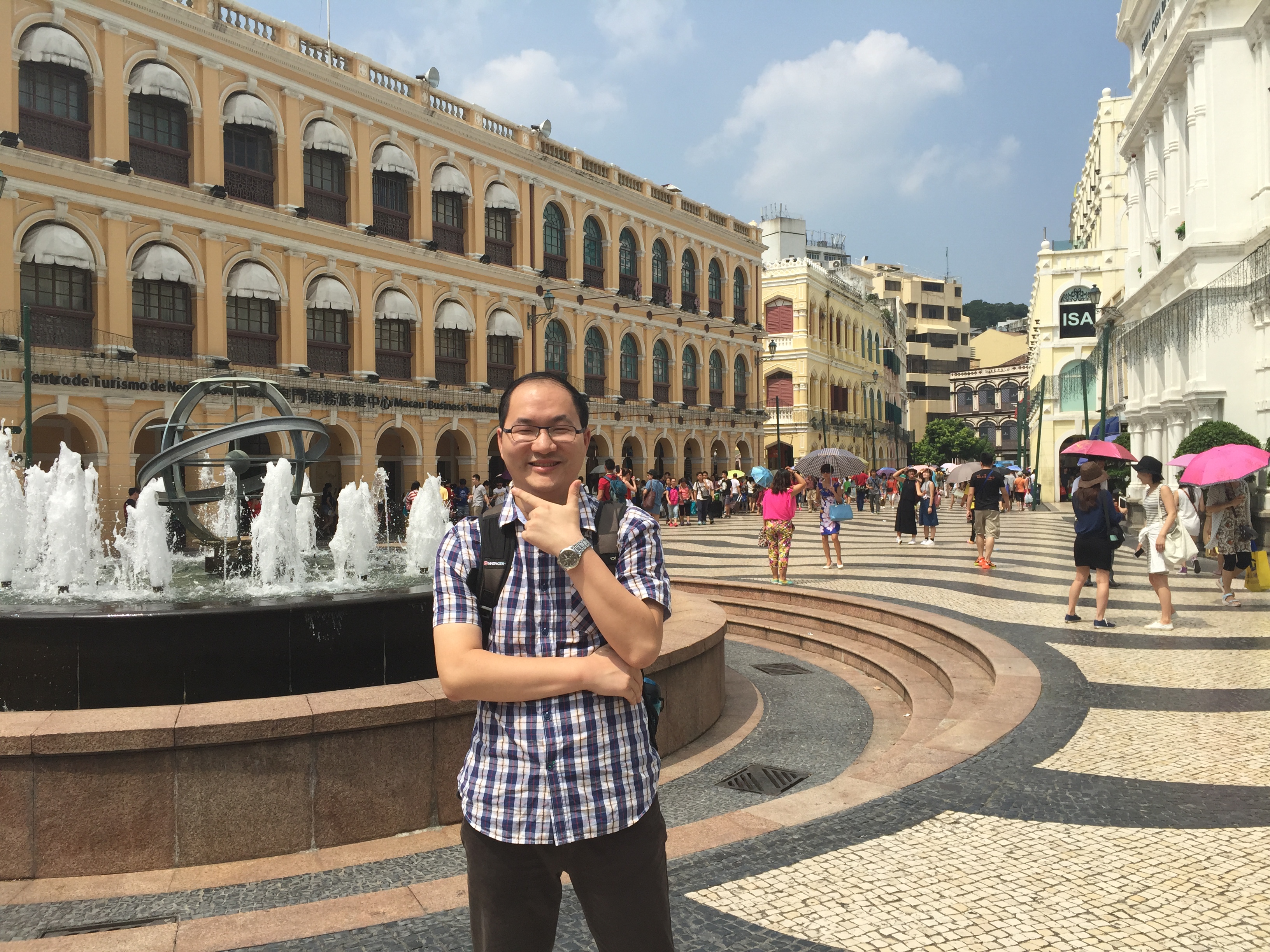
简介
钟俊江,男,江西兴国人
1981年09月出生
副教授,博士,硕士生导师
研究方向:临床试验、自适应设计、生物医药统计、强化学习
Email:jjzhong@xmut.edu.cn
教育背景
2017年01月毕业于台湾成功大学统计学专业,修业时间3.5年,获博士学位
2007年07月毕业于北京师范大学概率论与数理统计专业,修业时间3年,获硕士学位
2004年07月毕业于东北师范大学数学与应用数学专业,修业时间4年,获学士学位
工作经历
2019年07月-2019年08月 香港中文大学统计系 Research Associate
2018年07月-2018年08月 香港中文大学统计系 Research Associate
2017年06月-2017年09月 香港中文大学统计系 Postdoctoral Fellow
2015年06月-2015年10月 香港中文大学统计系 Research Assistant
2007年08月-至今 厦门理工学院数学与统计学院
科研和教改项目
序号 |
起止时间 |
项目名称 |
主要贡献 |
项目级别 |
1 |
2021.08-2024.07 |
临床试验中基于自适应和成组序贯设计的融合优化研究 |
主持 |
教育部人文社会科学研究青年基金项目,编号:21YJC910011 |
2 |
2023.01-2026.01 |
自适应临床试验设计的样本量重新估计研究 |
主持 |
福建省自然科学基金面上项目,编号:2023J011433 |
3 |
2022.07-2025.06 |
药物临床试验中多重适应性设计研究 |
主持 |
厦门市自然科学基金面上项目,编号:3502Z20227220 |
4 |
2019.12-2021.12 |
可变界值的非劣效临床试验研究 |
主持 |
2019年福建省中青年教师教育科研项目,编号:JAT190665 |
5 |
2015.06-2018.05 |
识别药物最小有效剂量的多重比较理论及应用研究 |
主持 |
2016年福建省中青年教师教育科研项目,编号:JA15360 |
6 |
2022.08-2022.12 |
投资项目的周期监测 |
主持 |
厦门市高质量发展统计监测中心 |
7 |
2022.11-2022.12 |
厦门市思明区“美丽河湖”建设成效公众满意度调查 |
主持 |
厦门市思明生态环境局 |
8 |
2021.11-2022.03 |
厦门各级学龄人口中长期预测模型构建研究 |
主持 |
厦门市第七次全国人口普查课题 |
9 |
2021.12-2022.03 |
基于Leslie模型的漳州学龄人口中长期预测研究 |
主持 |
漳州市第七次全国人口普查课题 |
10 |
2024.05-2024.07 |
促进厦门市新质生产力发展政策研究 |
参与 |
福建省人民政府发展研究中心决策咨询研究重大课题,编号:2024JCZX06 |
11 |
2023.11-2024.03 |
厦门市旅行服务贸易统计研究 |
参与 |
厦门市商务局 |
12 |
2023.12-2024.02 |
闽南文化生态保护区(厦门)建设成效评估 |
参与 |
厦门市文化与旅游局 |
13 |
2021.12-2022.03 |
福建省人口长期均衡发展及其举措研究 |
参与 |
福建省第七次全国人口普查课题 |
14 |
2021.12-2022.03 |
漳州市人口结构演变及其与区域经济的关联研究 |
参与 |
漳州市第七次全国人口普查课题 |
15 |
2020.12-2021.03 |
厦门市基本公共服务均等化状况研究 |
参与 |
厦门市统计学会 |
16 |
2013.01-2013.06 |
统计工作标准化研究课题组 |
参与 |
厦门市统计局与厦门理工学院联合项目 |
教材建设
1. 钟俊江 副主编.概率论与数理统计[M]. 厦门:厦门大学出版社, 2022.
发表论文(*通讯作者,#共同一作)
1. Zhong J, Lu, T-Y Lin Y*, Cheung SH. 2026. Invariance Property of the latent Weibull test for comparing ordinal data. Communications in Statistics–Theory and Methods. Online Published. DOI:10.1080/03610926.2026.2687766.
2. Ma Y, Zhang F, Zhong J*. 2026. Robust specification testing for rank-based linear regression. The Econometrics Journal. Online Published. DOI:10.1093/ectj/ utag014.
3. Zhong J, Hu X, Gao J, Cheung SH*. 2026. Sample size determination for response-adaptive randomization with recurrent event responses and unequal follow-up time. Statistics in Medicine. 45: e70611.
4. Li J, Lin P, Zhen X, Zhong J*. 2026. Abundant new lump type interaction wave solutions and nonlinear dynamics for the (4+1)-dimensional Fokas equation. Networks and Heterogeneous Media. 21(3): 865–893.
5. Hung JY#, Zhong J#, Ou HT, Su PF*. 2026. Efficient estimation of Cox model when incorporating the subgroup restricted mean survival time. Journal of Biopharmaceutical Statistics. 36(3):527-548.
6. Xu J#, Yuan F#, Weng W*, Zhong J, Li Y, Chen L, Chen B. 2026. A triple rewards framework for multi-agent reinforcement learning. Applied Soft Computing. 190: 114541.
7. Zhong J, Guo H, Sun N, Li J*. 2025. Two-stage Fill-it-up design method incorporating historical control data in binary endpoint clinical trials. AIMS Mathematics. 10(12):29168-29188.
8. Lu T-Y, Lin Y*, Zhong J. 2025. Response-adaptive treatment randomization for trials comparing multiple treatments with ordinal response. Journal of the Korean Statistical Society. 54:1147-1173.
9. Zhu Y, Li K, Huang C, Xu Y, Zhong J, Li J*. 2025. Abundant exact solutions of the fractional (3+1)-dimensional Yu-Toda-Sasa-Fukuyama (YTSF)Equation using the Bell Polynomial-based neural network method. Chaos, Solitons and Fractals. 196:116333.
10. Zhong J*, Lu C, Luo W. 2025. An improved method for multiple comparisons with ordinal categorical data. Journal of Xiamen University of Technology. 33(1):85-89. (in Chinese)
11. Zhu Y, Huang C, He S, Chen Y, Zhong J, Li J*, Zhang R*. 2024. Interactions of localized wave and dynamics analysis in the new generalized stochastic fractional potential-KdV equation. Chaos. 34(11):113114.
12. Zhong J*, and Luo W. 2024. Multiple-Plays Multi-armed Bandit with Accelerated Thompson Sampling. 7th International Conference on Computer Information Science and Application Technology. 1301-1306.
13. Ma Y*, Zhong J, Zhu N. 2023.Weighted hypergraph learning and adaptive inductive matrix completion for SARS-CoV-2 drug repositioning. Methods. 219: 102-110.
14. Ma Y, Zhong J*. 2023. Layout optimization based on two-stage genetic algorithm and greedy strategy[J]. Journal of Xiamen University of Technology.31(3):79-87. (in Chinese)
15. Su PF*, Zhong J, Liu YC, Lin TS and Ou HT. 2023. Efficient estimation of a Cox model when integrating the subgroup incidence rate information. Journal of Applied Statistics. 50(10):2151-2170.
16. Ma Y*, Zhong J. 2023. Logistic tensor decomposition with sparse subspace learning for prediction of multiple disease types of humanvirus protein-protein interactions. Briefings in Bioinformatics. 24(1), bbac604.
17. Wang WM*, Wen CC, Hung TH, Zhong J and Wen MJ. 2022. Single-stage sampling procedure for heteroscedasticity analysis of means. Brazilian Journal of Probability and Statistics. 36(4): 704-724.
18. Yu Y, Xu C*, Zhong J and Cheung SH. 2022. Comparison of treatments with ordinal responses in trials with sequential monitoring and response-adaptive randomization. Statistics in Medicine. 41(25): 5061-5083.
19. Zhong J*, Wen MJ, Cheung SH and Poon WY. 2022. Simultaneous tests of non- inferiority and superiority in three-arm clinical studies with heterogeneous variance. Communications in Statistics-Theory and Methods. 51(1): 249-266.
20. Sun N, Zhong J* and Wen MJ. 2021. Bayesian two-stage design for drug screening trials with switching hypothesis tests based on continuous endpoints. Communications in Statistics-Theory and Methods. 50(2): 415-431.
21. Zhong J, Wen MJ and Cheung SH*. 2020. Identification of the minimum non-inferior dose in a three-arm non-inferiority trial. Journal of the Korean Statistical Society. 49 (4): 1238-1254.
22. Su PF*, Zhong J and Ou HT. 2019. Semiparametric additive rates model for recurrent events data with intermittent gaps. Statistics in Medicine. 38(8): 1343-1356.
23. Zhong J, Wen MJ, Kwong KS and Cheung SH*. 2018. Testing of non- inferiority and superiority for three-arm clinical studies with multiple experimental treatments. Statistical Methods in Medical Research. 27(6): 1751-1765.
24. Chen S, Huang W, Chen M, Zhong J and Cheng J. 2017. Airlines content recommendations based on passengers’ choice using Bayesian belief networks. Bayesian Inference, Dr. Javier Prieto Tejedor (Ed.), InTech, 349-363.
25. Lu TY*, Lin Y and Zhong J. 2017. Pairwise comparisons of treatments with ordinal responses in a two-way setting. Communications in Statistics-Theory and Methods. 46(21): 10549-10563.
26. Wen MJ, Huang LC and Zhong J*. 2017. Single-Stage sampling procedure of the t best populations under heteroscedasticity. Communications in Statistics- Theory and Methods. 46(18): 9265-9273.
获奖
1. 2023年12月荣获2020-2023年度厦门市记功奖励;
2. 2023年指导学生在美国大学生数学建模竞赛中荣获1个Meritorious Winner (国际一等奖);
3. 近年来指导学生在全国大学生数学建模竞赛中荣获3个全国一等奖、2个全国二等奖、9个省一等奖、9个省二等奖;
4. 2021年以来指导学生在全国研究生数学建模竞赛中荣获6个全国二等奖、8个全国三等奖;
5. 2021年以来指导学生在全国大学生统计建模大赛荣获1个研究生组全国二等奖、1个省一等奖,1个本科生组全国三等奖、1个全国优秀奖、1个省一等奖、2个省二等奖,2022年8月荣获全国大学生统计建模大赛“优秀指导教师奖”;
6. 2021年以来指导学生在全国大学生市场调查与分析大赛中荣获2个本科组全国三等奖、1个省一等奖;
7. 2017年6月博士论文荣获Chinese Institute of Probability and Statistics ‘Wei Ching-Zong Memorial Award’;
8. 2016年6月在第三届福建省高校青年教师教学竞赛中荣获“自然科学基础学科组三等奖”;
9. 2013年9月荣获2010-2013年度“厦门市优秀教师”称号;
10. 2013年在厦门理工学院第六届青年教师课堂教学竞赛中荣获一等奖;
11. 2011年荣获全国大学生数学建模竞赛“优秀指导教师”称号;


